

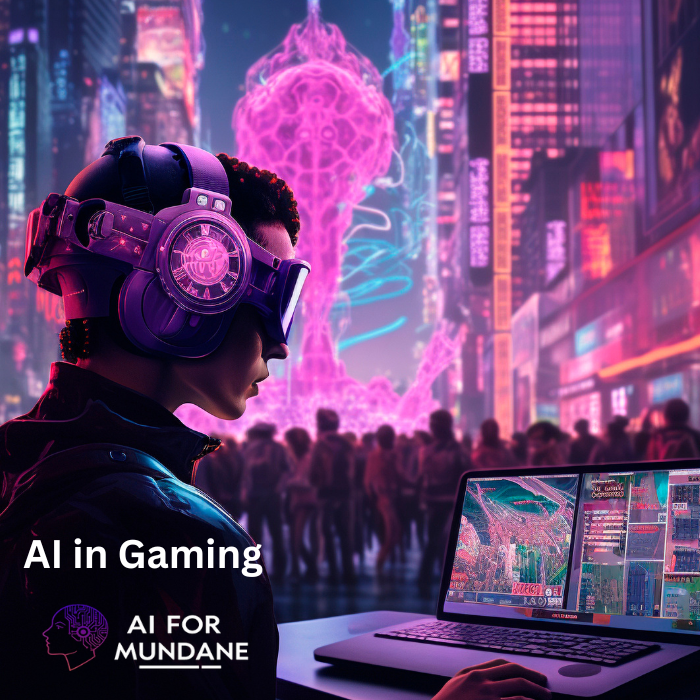
Deep Reading on AI in Gaming: Going Beyond the Mundane
Welcome to www.aiformundane.com. In this deep dive, we move beyond AI’s role as a task automator and efficiency booster to explore how it is fundamentally reshaping the very fabric of video games and the metaverse.
In our last series, AI in Gaming & Metaverse (Point 15), we touched on how AI streamlines the mundane tasks of content creation and moderation. Now, let’s peel back the layers to reveal how AI is evolving into something much greater: a creative partner, a social companion, and a guardian of virtual worlds.
1. The AI as a Creative Engine: Procedural Content Generation (PCG)
The Old Way: World-building once meant artists painstakingly placing every tree, mountain, or building—a slow, repetitive process.
The AI Way: AI-powered Procedural Content Generation (PCG) changes this. Trained on datasets of terrains, ecosystems, and design rules, AI can generate environments instantly. For example, instead of manually placing a thousand trees, a designer can simply instruct: “Generate a dense forest with a winding river and a few clearings.”
Beyond the Mundane: PCG isn’t just about saving time; it creates infinite possibility. Minecraft and No Man’s Sky use PCG to generate vast, unique worlds for every player. Designers are liberated from repetitive labor and can focus on storytelling and mechanics, while AI handles the heavy lifting of world creation.
2. The AI as a Social Partner: Realistic NPC Behavior
The Old Way: Non-Player Characters (NPCs) used to be stiff, scripted, and predictable—mere quest dispensers with robotic dialogue.
The AI Way: With Large Language Models (LLMs) and behavioral AI, NPCs can now learn, adapt, and converse dynamically. They can remember your past actions, adjust their tone, and generate novel dialogue that feels authentic.
Beyond the Mundane: Imagine an NPC shopkeeper who remembers that you saved their village and later offers you a discount or asks about your adventures. Tomorrow’s NPCs could evolve into companions, rivals, or even long-term allies—turning static worlds into vibrant social ecosystems.
3. The AI as a Curator: Personalized Gaming Experiences
The Old Way: Games were built as one-size-fits-all journeys. Players either adapted—or dropped out.
The AI Way: AI continuously analyzes play style, skill, and decision-making. Prefer stealth over combat? AI adjusts patrol routes to fit. Struggling with a boss? AI lowers difficulty or provides a subtle hint.
Beyond the Mundane: This isn’t just scaling difficulty. It’s creating bespoke adventures. Every adjustment ensures the game remains challenging but fair—keeping players engaged without tipping into frustration. Gaming shifts from a linear, pre-scripted path to a living journey shaped around the individual player.
4. The AI as a Guardian: AI-driven Moderation
The Old Way: Human moderators struggled with endless reports, toxic chat logs, and a Sisyphean task of cleaning digital spaces.
The AI Way: NLP-powered moderation systems detect harassment, hate speech, and other toxic behavior in real-time—scanning text, voice, and even behavioral patterns.
Beyond the Mundane: While it’s still a maintenance task at its core, AI moderation has a profound impact. By automating the bulk of toxicity detection, human moderators can focus on nuanced cases. More importantly, players enjoy safer, more inclusive spaces, protected by an always-on digital guardian.
Conclusion
AI in gaming is moving from the backstage to the spotlight. It’s not just a tool for optimization anymore—it’s:
A creative engine that builds infinite worlds
A social partner that makes NPCs truly alive
A curator that tailors gameplay to every individual
A guardian that keeps communities safe
As these technologies mature, the boundary between human-crafted and AI-generated will blur, giving rise to gaming experiences that are more immersive, personal, and alive than ever before.