

AI for Mundane: A Blog for the Modern Adult (18-30)
Welcome to www.aiformundane.com, where we explore how artificial intelligence can make everyday life a little easier.
If you’re between the ages of 18 and 30, you’re not just a passive user of AI—you’re on the front lines, navigating a world where AI is already embedded in your work, finances, and even personal life. For this age group, AI isn’t futuristic—it’s part of the mundane present.
Young adults today are the most likely to use AI across a wide range of tasks, from brainstorming and content creation to managing personal finances. Let’s dive into the “tools” shaping everyday life.
The “Tools” of AI for the 18-30 Age Group
For modern adults, AI is more than a toy—it’s a multi-purpose co-pilot that automates the routine so you can focus on big-picture goals.
1. AI for Productivity and Work
This is where AI blends seamlessly into the mundane. Over 70% of adults under 30 now use AI for work-related tasks and brainstorming.
Generative AI (e.g., Google Gemini): Draft emails, summarize long documents, or help with coding to break through initial blocks and dive into deeper work.
Project Management & Scheduling (Motion, Notion AI): Automate scheduling, optimize calendars, and build project timelines—reducing the mental load of planning.
Transcribing & Note-Taking (Otter.ai): Turn lectures or meetings into searchable, text-based documents in minutes.
2. AI for Personal Finance
Managing money is a major stress point for young adults—AI is stepping in to simplify.
Budgeting & Savings Apps (Cleo, Monarch Money): Track spending, predict expenses, and receive tailored recommendations to save more effectively.
Investment & Trading Bots: AI-powered robo-advisors rebalance portfolios, diversify investments, and execute trades automatically (with caution).
3. AI in Social Life and Dating
AI is quietly reshaping how we connect.
Dating Assistants (Facebook Dating, Hinge AI features): Personalized matchmaking, profile tips, and swipe fatigue relief.
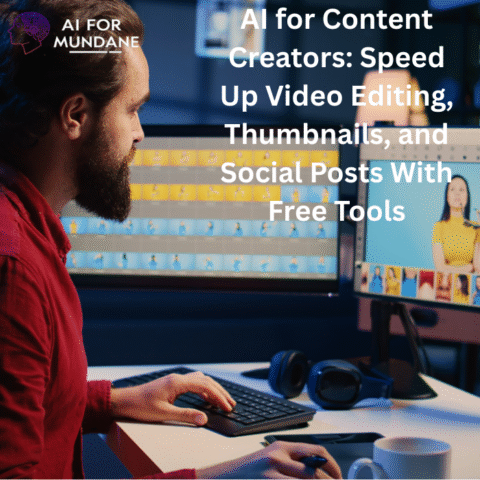
Social Media & Content Creation (Canva AI, DALL·E): Generate images, graphics, and even video content instantly, fueling the creator economy.
The Challenges and the Future
AI brings opportunity—but also challenges. According to Pew Research Center, workers ages 18–29 are the most likely to feel overwhelmed by AI in the workplace. Entry-level jobs may disappear due to automation, yet new roles are emerging in AI ethics, prompt engineering, and data science.
For the modern adult, AI isn’t a passing trend—it’s the baseline. The key is to view AI as an augmentation of human skills, not a replacement. Mastering AI frees up time and energy for what truly matters: creativity, empathy, and building a meaningful life.
Deep Reading: AI in Gaming — Going Beyond the Mundane
Welcome back to www.aiformundane.com. In this deep dive, we move beyond task automation to explore how AI is fundamentally reshaping video games and the metaverse.
Earlier, we looked at how AI streamlined mundane tasks like content creation and moderation. Now, we’ll peel back the layers to see how AI is becoming a creative, social, and transformative force in gaming.
1. AI as a Creative Engine: Procedural Content Generation (PCG)
Traditionally, game designers painstakingly crafted every detail of a world. This “mundane” work is being revolutionized by AI-powered Procedural Content Generation (PCG).
How it works: Trained on massive datasets of terrains, rules, and assets, AI generates vast worlds from simple prompts like “Create a dense forest with a winding river.”
Beyond the mundane: Games like Minecraft and No Man’s Sky showcase infinite, procedurally-generated universes. Designers now focus on storytelling and mechanics, leaving repetitive world-building to AI.
2. AI as a Social Partner: Realistic NPC Behavior
NPCs used to be static, predictable, and repetitive. Now, AI is giving them personality and memory.
How it works: Large Language Models (LLMs) enable NPCs to generate unscripted, dynamic conversations, remember past interactions, and adapt behavior.
Beyond the mundane: Imagine a merchant NPC who remembers that you saved their village and later offers you discounts or companionship. NPCs become evolving characters, not just quest-givers.
3. AI as a Curator: Personalized Gaming Experiences
The “one-size-fits-all” model is fading as AI tailors gaming for each player.
How it works: AI analyzes play styles, adjusting difficulty, creating stealth-friendly paths, or offering in-game hints.
Beyond the mundane: The experience evolves around the player—always engaging, never frustrating—turning linear journeys into adaptive adventures.
4. AI as a Guardian: AI-Driven Moderation
Toxicity is one of gaming’s biggest challenges, and moderation is an endless, mundane task.
How it works: NLP-powered AI moderates chats, voice logs, and even in-game actions in real time to detect harassment or hate speech.
Beyond the mundane: Automated moderation ensures safer, more inclusive communities while freeing human moderators for complex cases.
Conclusion: From Background Tool to Creative Partner
AI in gaming is moving from the back-end to the front-end. It’s no longer just an optimization tool—it’s:
A creative engine generating infinite worlds,
A social partner bringing NPCs to life,
A curator personalizing every journey, and
A guardian protecting online spaces.
As AI evolves, the line between human-created and AI-generated content will blur, ushering in immersive, adaptive, and living game worlds unlike anything before.